

Part 1 . EN 1176 Series: Overview and Purpose
The EN 1176 series is the European standard for "Playground equipment and surfacing." Its primary purpose is to ensure a proper level of safety for children while using playground equipment, while also promoting activities that are beneficial for children's development. The standard is based on the philosophy that playgrounds should balance the need for safety with the benefits of managed risk, allowing children to learn and develop in a stimulating environment.
Scope and Applicable Products:
The standards apply to permanently installed public playground equipment and surfacing. This includes equipment for individual and collective use, such as swings, slides, climbing frames, and fully enclosed play structures. It also covers equipment installed as playground apparatus, even if not originally manufactured as such.
Key Exclusions:
The standard generally excludes items defined as toys under the EN 71 standard and the Toys Safety Directive, adventure playgrounds (except for commercially sourced items within them), equipment using electricity as a play feature or motive force, and equipment placed in water.


Detailed Breakdown of Specific Parts
1. EN 1176-1: General Safety Requirements
This part establishes the foundational safety and testing requirements for all playground equipment.
Main Content:
It covers general hazards such as entrapment (head, neck, and body), sharp edges, protruding parts, durability of materials, structural integrity, and the stability of equipment. A key principle is protecting children from hazards they cannot reasonably foresee during normal or predictable use.
Compliance Parameters:
The table below summarizes key general requirements:
| Parameter Category | Key Compliance Requirements |
| Entrapment & Openings | Prevention of head/neck entrapment; specific dimensions for body/limb openings. |
| Structural Integrity & Load | Equipment must withstand static and dynamic loads from use; stability requirements to prevent tipping. |
| Materials & Durability | Materials must be durable, corrosion-resistant, and not splinter or crack to create hazards. |
| Surfacing | Requires impact-attenuating surfacing under and around equipment (governed by EN 1177). |
| Access & Guardrails | Specific requirements for guardrails and barriers on elevated platforms to prevent falls. |
2. EN 1176-3: Additional Requirements for Slides
This part specifies additional safety requirements specific to slides.
Main Content:
It addresses unique hazards associated with slides, including the design of the access ladder, the profile of the slide chute (straight, spiral, wavy), the exit region, and the landing area.
Compliance Parameters:
Key slide-specific parameters include:
| Parameter Category | Key Compliance Requirement |
| Slide Chute Profile | Specific radii for curves, transition zones, and chute sides to ensure controlled descent. |
| Access & Exit | Secure handholds on ladders; design of exit region to facilitate a stable, seated landing. |
| Fall Height & Use Zone | Clear space requirements in front of the exit based on the slide's height and configuration. |
3. EN 1176-10: Additional Requirements for Fully Enclosed Play Equipment
This part covers equipment where play occurs inside a structure, such as large multi-level play towers or complex tunnel systems.
Main Content:
It focuses on hazards within confined spaces, including visibility, ventilation, fire safety, emergency exits, and the risk of congestion. The standard aims to prevent children from becoming trapped or hidden from supervisors' view.
Compliance Parameters:
Key parameters for enclosed equipment include:
| Parameter Category | Key Compliance Requirements |
| Visibility & Supervision | Requirements for windows, netting, or open sections to allow visual supervision from outside. |
| Ventilation | Adequate airflow must be ensured within enclosed compartments. |
| Escape & Egress | Mandatory provision of clearly identifiable, unobstructed emergency exits in addition to normal entrances. |
| Internal Layout | Avoidance of internal dead-ends and design to prevent crowding and panic. |

Part 2 . The Complete EN 1176 Standard Series
The EN 1176 series is the European standard for "Playground equipment and surfacing." Part 1 establishes the general safety requirements for all permanently installed public playground equipment. The subsequent parts provide additional specific safety requirements and test methods for particular types of equipment.
The table below lists all parts of the EN 1176 series, including those already discussed:
| Standard Part | Focus / Equipment Type | Key Compliance Parameters & Notes |
| EN 1176-1 | General Requirements | Structural integrity, entrapment prevention, material durability, fall zones. Foundation for all other parts. |
| EN 1176-2 | Swings | Dynamic load testing, seat design, free space zone dimensions, prevention of impact with the supporting structure. |
| EN 1176-3 | Slides | Chute profile (curves, transition zones), access ladder design, exit region, and landing area requirements. |
| EN 1176-4 | Cableways | Wire rope integrity, trolley design, braking and impact systems, installation height and clearance zones. |
| EN 1176-5 | Carousels | Rotational speed limits, secure seating/handholds, centrifugal force management, edge protection. |
| EN 1176-6 | Rocking Equipment | This covers rocking horses and seesaws. Focus on stability, range of motion limits, and impact protection. |
| EN 1176-7 | Guidance | Installation, inspection, maintenance, and operation. Not a requirement standard but critical for safety management. |
| EN 1176-10 | Fully Enclosed Play Equipment | Visibility/supervision, ventilation, emergency egress, fire safety (references ignitability tests). |
| EN 1176-11 | Spatial Network | 3D climbing structures (e.g., net-based). Focus on mesh opening sizes, structural stability under multi-directional loads, and fall protection within the network. |
Additional Important Documents
EN 1177: Impact Attenuating Surfacing:
This is a separate but crucially linked standard. It specifies the test methods for determining the critical fall height (CFH) of surfaces like rubber or sand, which is essential for safe installation under any equipment from EN 1176.
CEN/TR 16396:2020:
This technical report provides official replies to requests for interpretation of the EN 1176 series, helping to clarify the application of requirements in practice.
Ongoing Development:
New technical specifications, such as one for bouncing facilities, are under development to supplement the test methods in EN 1176-1.
Importance of Compliance and Related Standards
Compliance with EN 1176 is crucial for manufacturers, installers, and playground operators (like municipalities and schools) to minimize the risk of serious injury. The standard is harmonized under the EU Construction Products Regulation, making it a key presumption of safety.
For a complete safety system, EN 1176 must be used alongside EN 1177, which specifies test methods for impact-attenuating surfacing (like rubber mats or bark chips) to minimize injury from falls. Furthermore, EN 1176-7 provides essential guidance on the installation, inspection, maintenance, and operation of playgrounds.
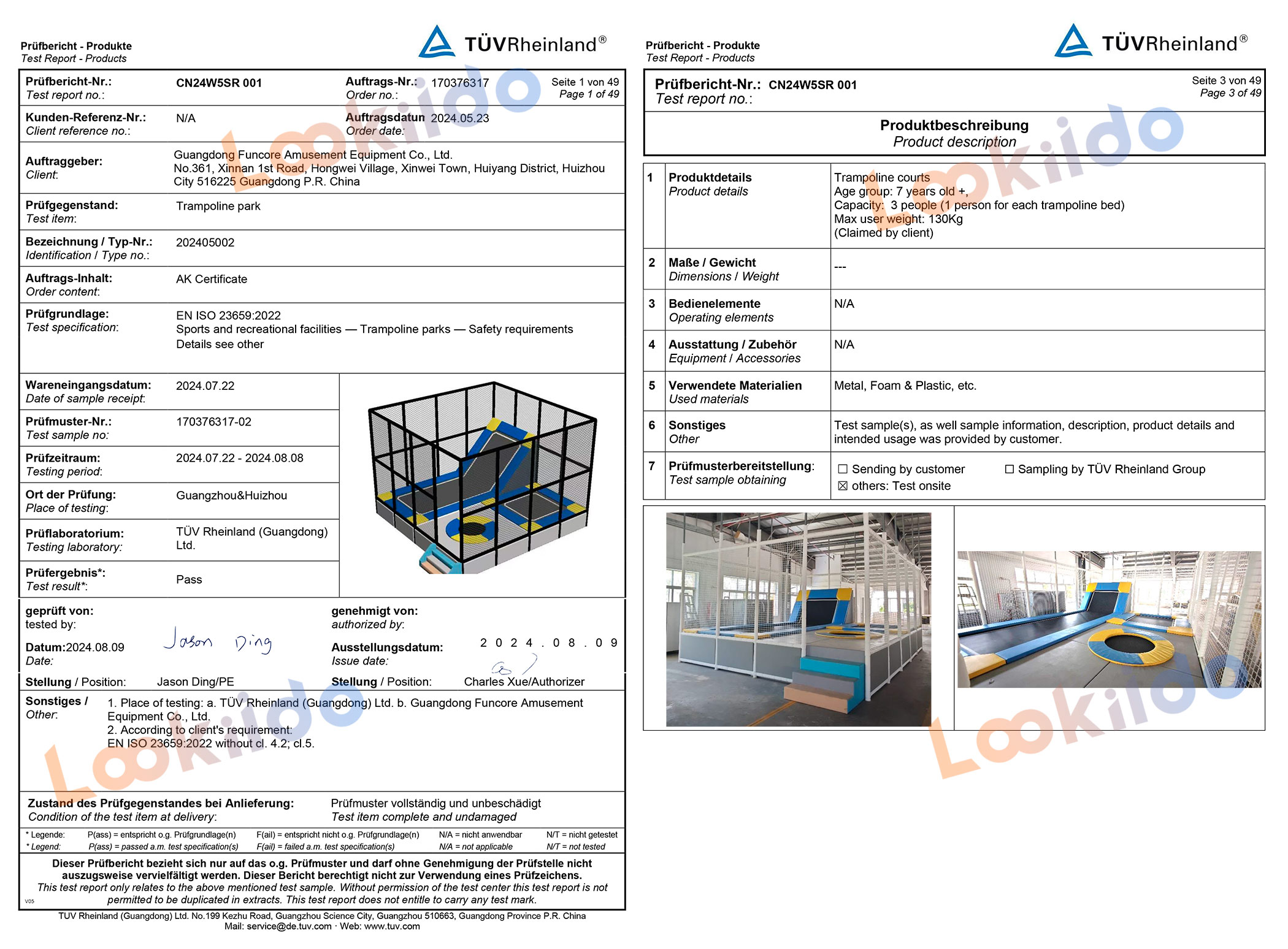
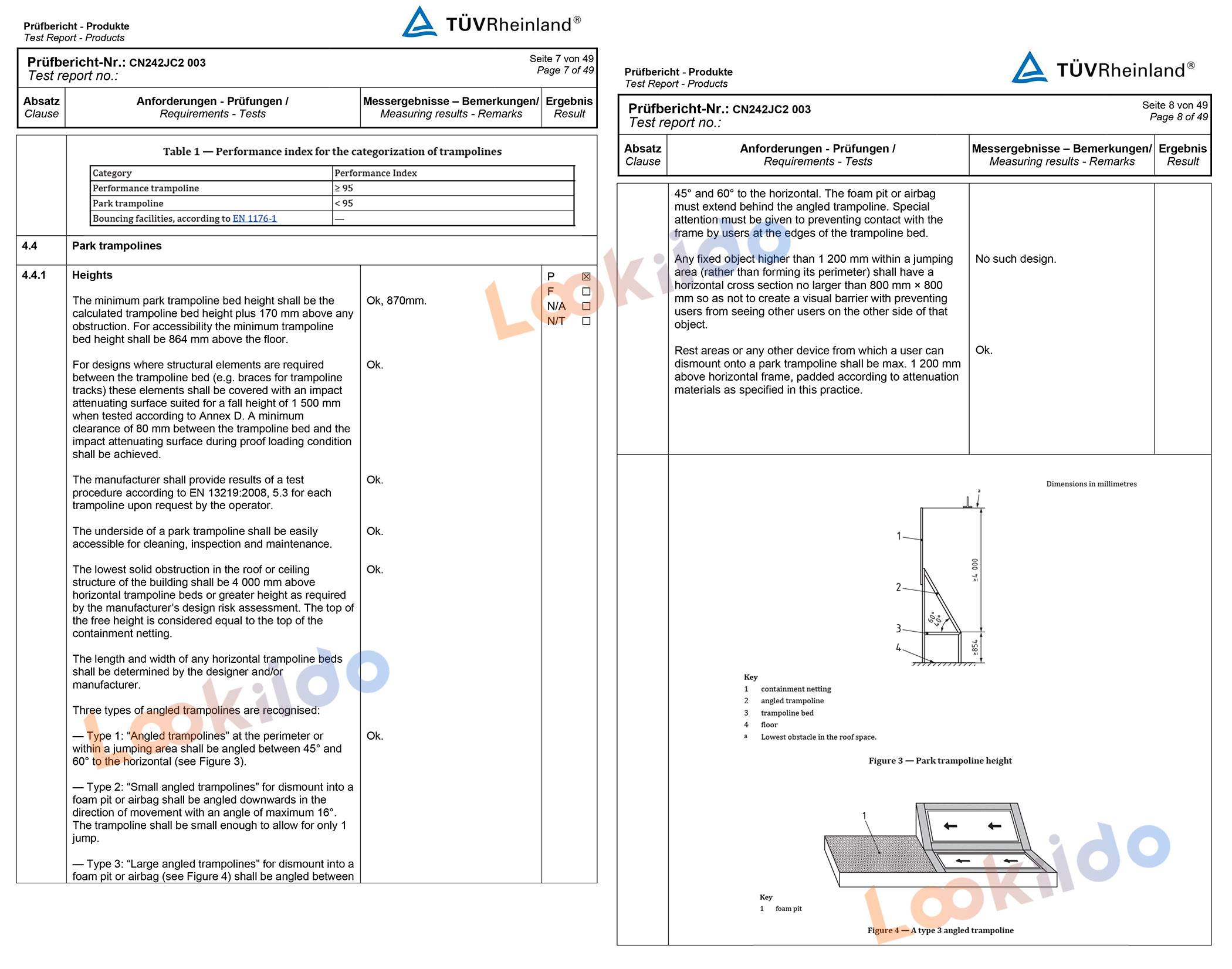
Part 3 . EN ISO 23659:2022 – Sports and Recreational Facilities
– Trampoline Parks – Safety Requirements
1. Overview
EN ISO 23659:2022 is an international safety standard that has been formally adopted as a European Norm (EN).
It specifies comprehensive safety and operational requirements for the design, construction, inspection, and maintenance of trampoline parks and their components. The standard aims to ensure an appropriate level of safety for users engaging in recreational, training, or educational activities within these facilities.
2. Purpose and Use
The primary purpose of this standard is to provide a unified set of safety rules to prevent accidents and injuries in trampoline parks. It is intended for use by all key stakeholders involved in the lifecycle of a trampoline park:
Manufacturers and Installers:
To design and construct equipment and parks that meet safety benchmarks.
Operators:
To establish and maintain safe daily operations, staff training, and maintenance protocols.
Inspectors and Enforcement Bodies:
To conduct objective assessments, certifications, and regulatory oversight.
3. Key Content and Requirements
The 68-page document covers two main areas: equipment/facility safety and operational management.
| Content Area | Key Requirements & Focus |
| Design & Construction | Covers the safety of trampoline beds, frames, padding, net enclosures, and integrated features like airbags and foam pits. It addresses hazards such as entrapment, collisions, falls from height, and the structural integrity of the entire assembly. |
| Inspection & Maintenance | Defines requirements for initial installation inspection, routine operational checks, and periodic comprehensive maintenanceto ensure ongoing compliance and safe condition. |
| Operational Management | Specifies minimum requirements for safe park operation, including user supervision, capacity management, safety briefing protocols, and staff training procedures. |
4. Scope and Applicable Products/Equipment
The standard applies to:
1. Dedicated indoor trampoline parks.
2. Trampoline park areas within larger multi-activity entertainment centers.
3. Associated landing equipment such as airbags and foam pits.
It is important to note the standard's key exclusions. EN ISO 23659:2022 explicitly does not cover:
1. Outdoor trampoline parks.
2. Non-trampoline activities (e.g., climbing walls, parkour, obstacle courses).
3. General building, fire, or planning regulations.
4. Food and drink provision or water quality.
5. The chemical composition of materials or general workplace safety for staff.
5. Key Technical Parameters and Compliance
The full standard contains detailed technical specifications and test methods which are critical for compliance. The following table outlines the primary areas where specific parameters are defined.
Note: Exact numerical values (e.g., dimensions, force thresholds, test frequencies) are specified in the complete standard document and cannot be fully detailed here.
| Parameter Category | Examples of Specific Requirements (Refer to Full Standard for Values) |
| Impact Attenuation | Performance requirements for safety padding and landing mats to minimize injury from falls. |
| Entrapment & Openings | Maximum and minimum gap sizes around springs, frames, and between nets to prevent head, neck, or limb entrapment. |
| Structural Integrity & Load | Requirements for static and dynamic load testing of frames, platforms, and connecting elements to ensure stability. |
| Fall Zones & Clearances | Minimum required clear space around and between trampolines, walls, and other obstacles to prevent collisions. |
| Performance & Dimensions | Specifications for trampoline bed tension, performance characteristics, and dimensional tolerances. |
| Inspection Frequencies | Defined intervals for daily visual checks, weekly operational inspections, and annual comprehensive inspections. |

Part.4 Why Do Standards Have the "EN ISO" Prefix?
The "EN ISO" prefix indicates that an international standard developed by the International Organization for Standardization (ISO) has been formally adopted as a European Standard (EN) by the European Committee for Standardization (CEN) or the European Committee for Electrotechnical Standardization (CENELEC). This prefix signifies that the document holds a dual status: it is technically identical to the global ISO standard but is also given the status of a mandatory standard across Europe.
The coordination between these organizations is governed by formal agreements, such as the ISO/CEN Vienna Agreement, which aims to avoid duplication of work and promote the adoption of international standards in Europe. The table below explains the meaning of each element in the prefix:
| Prefix Element | Meaning and Role | Key Implication |
| ISO | The International Standard. Developed through global consensus by the International Organization for Standardization. | Provides global relevance and technical foundation. |
| EN | The European Norm. Issued by CEN, CENELEC, or ETSI. All member countries' national standards bodies must adopt ENs as national standards and withdraw any conflicting ones. | Confers mandatory status within the European single market. Ensures uniform technical rules across Europe. |
| EN ISO | A single document that is both an International Standard (ISO) and a European Standard (EN). | Guarantees that a product or service complying with it meets both global best practices and specific European regulatory requirements. |
When an ISO standard is adopted as an EN, it becomes part of the European standardization system. CEN member countries are obliged to implement it as a national standard, often publishing it with a combined national prefix (e.g., BS EN ISO in the UK, DIN EN ISO in Germany).
The Broader "EN ISO" and "EN IEC" Phenomenon
The practice of adopting international standards as European ones is systematic and extensive, driven by the goal of eliminating technical barriers to trade within Europe and aligning with global markets. This phenomenon covers two main streams:
1. EN ISO Standards:
These are for non-electrical fields (e.g., mechanical, management systems, quality). A prominent example is the quality management standard EN ISO 9001.
2. EN IEC Standards:
These apply to the field of electrical and electronic engineering. International standards from the International Electrotechnical Commission (IEC) are adopted by CENELEC under the IEC/CENELEC Dresden Agreement. An example is the EN IEC 61000 series on electromagnetic compatibility.
A key report indicates that the adoption rate of international standards varies by sector: in the mechanical industry, about 30% of CEN standards are adoptions of ISO standards, while in the electrotechnical sector, CENELEC's adoption rate of IEC standards is as high as 90%. This high level of adoption means that for many products, a single international standard provides a direct path to compliance for both the European and global markets.
How to Use This Information
1. Always Start with Part 1:
Any playground equipment must first comply with the general safety requirements of EN 1176-1.
2. Apply the Specific Part:
Then, apply the relevant specific part (e.g., EN 1176-2 for swings, EN 1176-5 for carousels) for detailed design and test criteria.
3. Incorporate Surfacing Standards:
Safety requirements are not complete without planning for impact-attenuating surfacing per EN 1177.
4. Follow Management Guidance:
Implement the installation and maintenance guidelines from EN 1176-7 for long-term safety.


Dec. 08, 2025
The Complete Guide to Safety Standards for Indoor Playground Equipment (EN 1176 & EN ISO 23659)

Dec. 04, 2025
Safe Play, Healthy Kids: Why Non-Toxic Materials are the Heart of a Modern Indoor Playground

Dec. 01, 2025
Safety, Scale, and Savings: The Lookiido Advantage in Fire-Rated Indoor Playground Manufacturing

Jun. 10, 2025

May. 30, 2025

Jun. 28, 2025

Jun. 07, 2025

May. 30, 2025




